
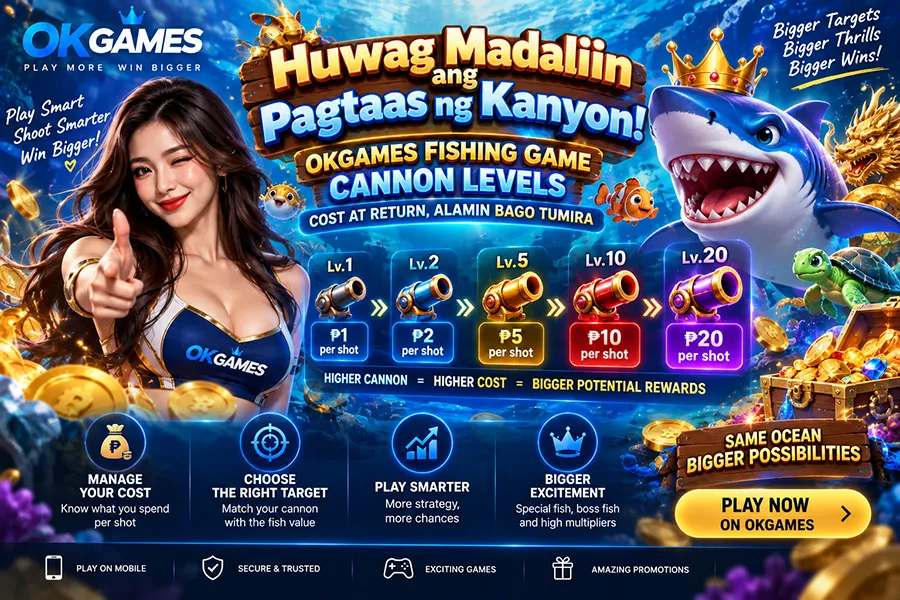
That giant boss fish enters the screen.
Your first instinct?
Upgrade the cannon. Fire harder. Go bigger.
Not so fast.
In our OKGames Fishing games, increasing your cannon level can give each shot more power—but it also increases what you put into every bullet.
And when you are firing again and again, a small difference in shot cost can become a very big difference in your balance.
The important question is not:
“What is the strongest cannon?”
It is:
“What am I paying per shot—and what am I actually shooting at?”
Bigger Cannon = Bigger Cost Per Shot
Fishing games work differently from slots.
You are not paying once for a spin.
Every shot matters.
If your selected cannon costs ₱1 per shot, firing 50 times means:
50 shots × ₱1 = ₱50
Raise the shot value to ₱5, and the same 50 shots become:
50 shots × ₱5 = ₱250
At ₱10 per shot:
50 shots = ₱500
Same number of shots.
Very different cost.
That is why upgrading the cannon can feel small when you tap the + button—but the real difference appears after continuous firing.
The higher the cannon value, the faster every missed shot adds up.
These amounts are simple examples. Actual cannon values depend on the Fishing game you open.
So Why Use a Higher Cannon?
Because bigger cannons are not useless.
Far from it.
Different fish can carry different values or multipliers, and larger or special creatures may require repeated shots before they are captured.
A stronger cannon changes the size of every shot you are putting into that target.
That can make higher cannon levels more exciting when the screen fills with:
- Larger fish
- Special creatures
- Boss targets
- High-value multipliers
- Limited-time targets
But there is an important catch:
A stronger cannon does not guarantee a catch.
You can raise the cannon.
You can fire repeatedly.
And the fish can still leave the screen.
When that happens, the cost of every shot is already gone.
Small Fish + Huge Cannon? Think About the Cost
This is where players often burn through coins faster than expected.
Imagine a screen full of ordinary small fish.
You do not necessarily need to keep the cannon at its highest available setting just because that setting exists.
If each bullet suddenly costs five or ten times more, shooting continuously at low-value targets can make the balance move very quickly.
That does not mean small fish are “good” and boss fish are “bad.”
It means the target value and shot cost should make sense together.
At OKGames, we would rather you understand what the cannon is costing you than simply keep pressing the upgrade button.
Boss Fish Look Tempting—for a Reason
Then the boss appears.
Big animation.
Big multiplier.
Big target.
Of course it gets attention.
Boss creatures are one of the most exciting parts of Fishing games, but they can also require repeated fire.
Suppose you are firing at:
₱5 per shot
After 10 shots, you have already used:
₱50
After 30 shots:
₱150
After 50 shots:
₱250
And capturing the boss is still not guaranteed.
That is the part players sometimes forget when they only look at the multiplier floating above the fish.
The reward is visible.
The accumulated bullet cost is easier to ignore.
Both numbers matter.
Cannon Level vs Number of Shots
Here is the easiest way to see the difference.
Imagine starting with a ₱500 session balance:
| Shot Cost | Maximum Shots From ₱500* |
|---|---|
| ₱1 | 500 shots |
| ₱2 | 250 shots |
| ₱5 | 100 shots |
| ₱10 | 50 shots |
| ₱20 | 25 shots |
*Simple cost illustration only, before any game returns.
That is the real trade-off behind cannon levels.
Lower Cannon
More shots from the same starting balance.
Higher Cannon
More value committed to every shot, but fewer total shots if catches do not replenish the balance.
Neither is automatically better.
They simply create very different sessions.
Auto-Fire Makes Cannon Cost Even More Important
One tap is easy to notice.
Twenty rapid shots?
Not so much.
If the Fishing title you are playing includes continuous or auto-fire features, always pay attention to your selected shot value before activating them.
At ₱1 per shot, a rapid sequence may look harmless.
At ₱10 or ₱20 per shot, that exact same firing speed changes the cost dramatically.
The cannon did not suddenly become “better.”
You simply increased how much each bullet represents.
Our Take: Don’t Upgrade Just Because You Can
The biggest cannon on the screen is not automatically the best cannon for every moment.
What matters is understanding three things:
Your shot cost.
How much leaves the balance every time you fire?
Your target.
Are you shooting at an ordinary fish or committing repeated shots to a large special target?
Your firing speed.
Are you taking individual shots or firing continuously?
Those three things can change the cost of a Fishing session much faster than many players expect.
And remember:
Higher cannon ≠ guaranteed higher return.
Fishing games still involve uncertain outcomes. A higher shot value changes how much you commit to each attempt; it does not guarantee that the next target will be captured.
The OKGames Bottom Line
When you enter one of our Fishing games, the temptation to keep upgrading the cannon is part of the excitement.
But bigger is not always better.
A higher cannon can make high-value targets feel more intense, while a lower setting lets the same balance cover more shots.
The smartest thing to notice is not the size of the cannon.
It is the number beside it.
Because in Fishing games:
Every bullet has a cost.
Every target has a value.
And the gap between those two is what really matters.
So when the next giant fish swims onto your screen—
don’t rush to upgrade your cannon. Check the cost first.